












Why Get ISO 27001 Certified?
ISO 27001 isn't a legal requirement, but it's become the price of entry for selling to enterprise and public-sector buyers. Certification proves, independently, that you manage information security properly. In practice it unlocks deals, replaces endless security questionnaires.
The real benefits of ISO 27001

Unlock your enterprise pipeline
In most UK public-sector and enterprise procurement, no certificate means no shortlist.

Stop drowning in security questionnaires
Hand over one certificate instead of answering a bespoke review for every prospect.

Contributes to UK GDPR diligence
A recognised way to evidence the "appropriate technical and organisational measures" the law expects.

Reduce the risk of a breach
A structured system replaces ad-hoc security decisions with controls reviewed on a schedule.

Lower your costs elsewhere
Often lower cyber-insurance premiums, and less time re-answering the same security questions.
When does ISO 27001 start to matter?
It rarely matters because you decided it should. It matters the moment a customer asks. That moment tends to arrive at a predictable point as you grow.
Startup
The moment it shows up:
Your first enterprise deal stalls on a security review.
Get ahead of it
Certify early, while your systems are still simple, and turn the blocker into a differentiator.
Mid-Market
The moment it shows up:
Security questionnaires pile up, and every one is bespoke
Get ahead of it
One certificate replaces the whole pile, so sales stops waiting on security.
Enterprise
The moment it shows up:
Buyers and regulators assume you already have it.
Get ahead of it
It becomes table stakes, and often something you need before you can onboard your own vendors.
Not there yet? If no one is asking and you hold little sensitive data, a lighter scheme like Cyber Essentials may be the right first step. We'll tell you straight if that's you.

How you actually get certified
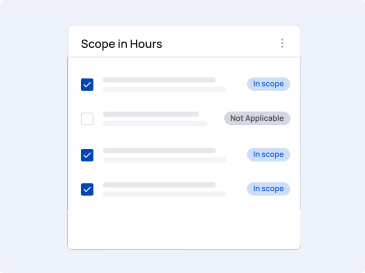
Scope in Hours
Tell us what the certificate needs to cover. We agree the boundary: teams, sites and systems. Then we set out the records the audit will call for, so nothing is a surprise on the day.
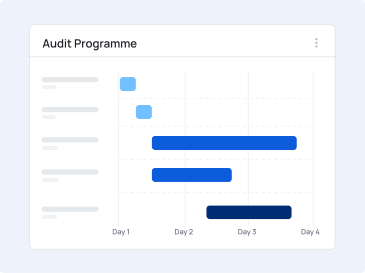
Audit Without the Back-and-Forth
Our process reviews evidence accurately. A named lead auditor focuses on the judgement calls only a human should make.
Certified in Days
If the audit is successful, an impartial certification panel issues your accredited certificate. You leave with credentials your enterprise customers trust.
ISO 27001, answered
Yes, if you sell to enterprise, public-sector or regulated buyers. For them it directly unlocks deals and removes repeated security reviews. If no one is asking and you handle little sensitive data, it may not be worth it yet.
No. There is no law that requires it. In practice, though, many enterprise and public-sector contracts make it a condition of doing business, which is why it can feel mandatory once you sell upmarket.
Companies whose customers ask for proof that information security is managed properly: typically B2B software and services selling to enterprise, government or regulated industries. If your buyers send security questionnaires, you're in the audience.
It depends on the size and complexity of the system being certified: how many people are in scope, and how your ISMS is put together. We quote a fixed price up front after scoping, with no hidden audit-day arithmetic.
With Calibre, the audit itself takes days rather than months. The longer variable is how ready your ISMS is: scoping tells you exactly what evidence is needed, so you know the full timeline before you commit.
Cyber Essentials is a UK baseline scheme covering a fixed set of technical controls, largely self-assessed. ISO 27001 certifies a whole management system for information security, independently audited. Buyers treat them very differently: one is hygiene, the other is proof.
SOC 2 is an attestation report common with US buyers; ISO 27001 is a certification against an international standard, and the default ask in the UK and EU. They overlap heavily, so holding one makes the other significantly easier.
GDPR is law about personal data; ISO 27001 is a standard for managing information security. You can't be 'GDPR certified', but ISO 27001 is a recognised way to evidence the technical and organisational measures GDPR expects.
The standard was revised in 2022, with controls covering cloud, threat intelligence and secure development. What can feel outdated is the traditional audit process around it, which is exactly the part we've rebuilt.
It's work, but it's tractable. The effort scales with your scope and how much structure you already have. Most of the difficulty in the traditional route is process friction rather than the standard itself: months of document exchange and unclear expectations.
Certification, without the drag.
A process built for how modern teams actually work, run by tech-first auditors, and honest about what you do and don't need.